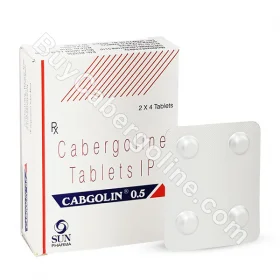
Cabgolin 0.5 mg is a brand of cabergoline, a prescription tablet that lowers the hormone prolactin. This page puts safety first: it explains who should and should not take it, what to watch for, and how to avoid the most common mistakes with this medicine.
The most important points are that it is normally taken once or twice a week and not daily, that it needs a prescription and follow-up blood tests, and that anyone with certain heart, lung or blood pressure conditions should avoid it.
If you want to understand how brands and generics relate, the FDA's generic drugs questions and answers explains how products with the same active ingredient are approved.
Common mistakes to avoid
- Taking it daily. The standard schedule is once or twice a week. A daily dose is far higher than usual labelling unless a specialist has directed it.
- Raising the dose yourself. Increases are made by your doctor, no sooner than every four weeks, based on blood tests.
- Doubling up after a missed dose. Take the missed dose when you remember unless the next is close, and do not take two together.
- Stopping suddenly. Prolactin and symptoms can return, so ask your doctor first.
- Assuming it is safe in pregnancy. It is not automatically safe or unsafe, so talk to your doctor before trying to conceive, or immediately if you become pregnant.
- Buying without a prescription. That removes the diagnosis and monitoring that make treatment safe.
What Cabgolin 0.5 mg is used for
- High prolactin (hyperprolactinaemia), which can cause irregular periods, infertility, milk-like discharge, low sex drive and erectile problems. See cabergoline and prolactin.
- Prolactinomas, small pituitary tumours that make prolactin. See cabergoline and prolactinoma.
- Preventing or stopping milk production where a doctor judges it appropriate.
How it works
Cabergoline stimulates dopamine D2 receptors in the pituitary, mimicking the signal that restrains prolactin release, so prolactin falls. It acts for days after each dose. Learn more in cabergoline and dopamine.
Dosage and administration
Your prescriber chooses your dose. These are typical label ranges.
- Start: 0.25 mg twice a week, or 0.5 mg once a week.
- Increase: small steps, no sooner than every four weeks.
- Usual range: about 0.5 to 1 mg a week, with the labelled upper limit around 1 mg twice a week.
- Take with water, with or without food. Avoid soft drinks or alcohol around the dose if they make you dizzy.
- Smaller strength: Cabgolin 0.25 mg is sometimes used for starting or fine-tuning.
If the current strength does not seem to help, speak to your doctor, and do not move up to a stronger tablet on your own. See the dosage guide and how often to take cabergoline.
Overdose
Too much can cause fainting, hallucinations, severe dizziness and a racing heartbeat. Contact your doctor or poison control straight away, and seek emergency care if symptoms are serious.
Side effects
Common
- Nausea, vomiting, constipation or stomach upset
- Dizziness, light-headedness and drowsiness
- Headache
- Blurred vision or difficulty concentrating
Stop and seek medical help
- Chest pain, breathlessness or a persistent cough
- Swelling of the skin, feet or legs
- Hallucinations or confusion
- Compulsive urges to gamble, spend, eat or seek sex
- Severe abdominal or back pain
See side effects.
Interactions
- Dopamine-blocking medicines such as haloperidol, chlorpromazine and metoclopramide.
- Macrolide antibiotics, azole antifungals and HIV protease inhibitors, which may raise cabergoline levels.
- Other ergot-derived medicines such as bromocriptine.
- Blood pressure medicines, which can add to dizziness.
- Alcohol, which can worsen drowsiness and poor concentration.
Who should avoid it, or take extra care
- Avoid with heart valve disease, a history of fibrosis in the lungs, heart or abdomen, uncontrolled high blood pressure, or allergy to ergot medicines. See heart valve risk.
- Liver disease: the drug can build up, so dosing may need to be lower. Kidney problems should also be discussed.
- Pregnancy and breastfeeding: discuss with your doctor. It can restore ovulation and it lowers milk supply.
- Drivers and machinery users: be careful until you know how you respond.
The full list is in who should avoid cabergoline.
Buying Cabgolin 0.5 mg safely
Use a registered pharmacy and a valid prescription, and check the pack for the strength, batch number, expiry and manufacturer. Prices vary by country and pack size, so compare total cost with caution, and be wary of anything far cheaper than normal. Our safe buying guide lists what to check.
Frequently asked questions
Is Cabgolin the same as cabergoline?
Cabgolin is a brand name, and cabergoline is the active ingredient.
Can I drink alcohol?
Alcohol can add to dizziness and drowsiness, so it is wise to limit it, especially early on.
Does it affect the liver or kidneys?
Liver disease can raise cabergoline levels, so tell your doctor. For kidney problems, ask your doctor or pharmacist about your dose.
Is it safe in pregnancy?
Speak to your doctor before conceiving, and straight away if you become pregnant. Do not rely on a blanket "safe" claim.
This page is general information, not medical advice. Cabergoline is a prescription medicine and should be used only under the guidance of a qualified healthcare professional.


Leave A Review